Types of Camera Shots: A Viewer's Guide to Framing and Angles
Types of camera shots explained: shot sizes from extreme wide to extreme close-up, the main camera angles, camera movement and what each choice tells a viewer.
- Bin
- Film
- Box code
FLM 03- Added
- Read time
- 5 min read
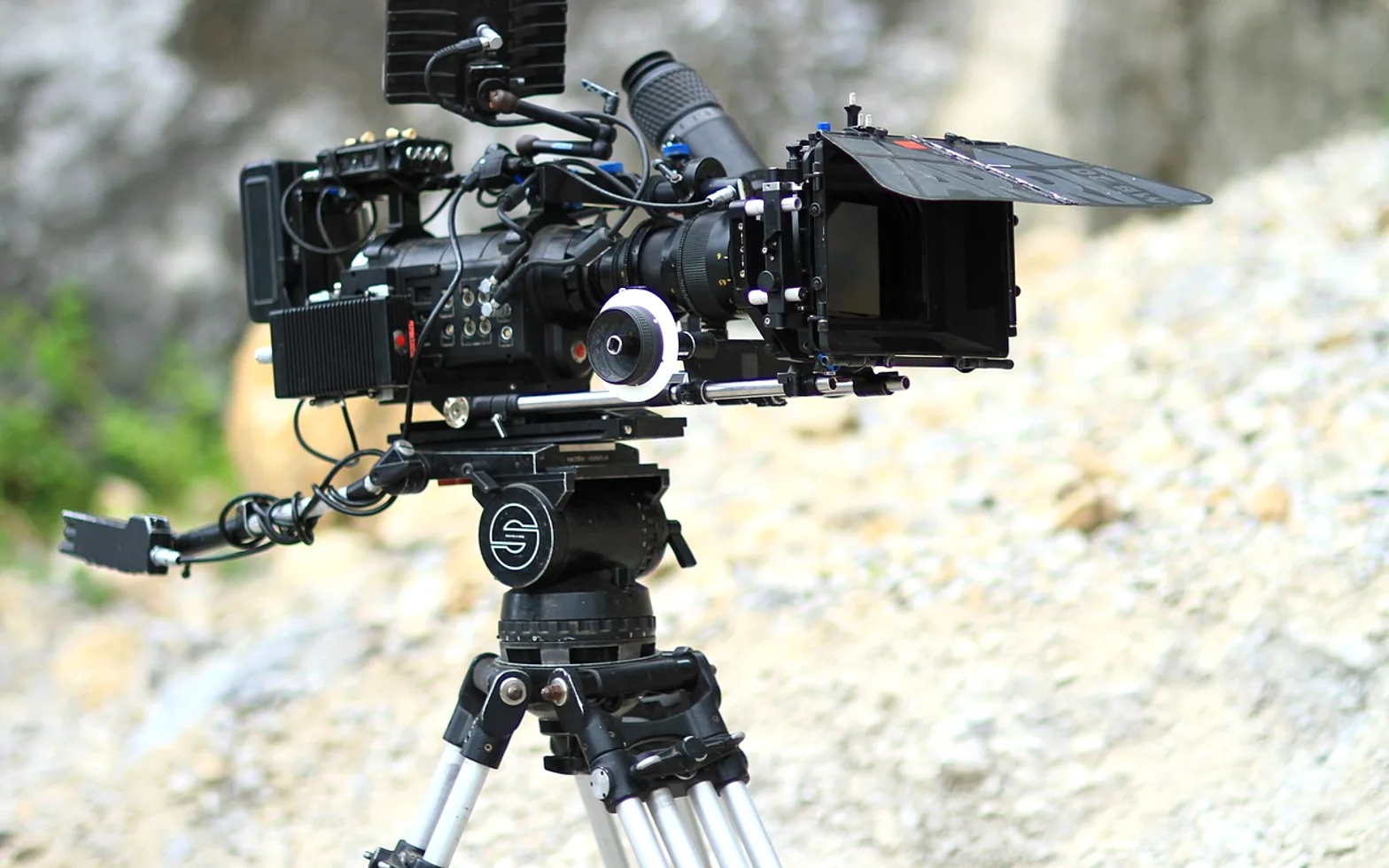
Camera shots are usually described in three ways: by size (how much of the subject fills the frame), by angle (where the camera sits in relation to the subject) and by movement. Sizes run from the extreme wide shot to the extreme close-up, angles from overhead to ground level, and movement from a locked-off frame to a sweeping crane. Learn a dozen terms and you can describe almost any image in any film.
Why bother? Because once you can name a shot, you start to see why it was chosen. Framing is never neutral. Every cut from wide to close is a small instruction about where to look and how to feel.
Shot sizes, from far away to very close
| Shot | What fills the frame | What it usually does |
|---|---|---|
| Extreme wide shot | A landscape, city or building; people are tiny or absent | Sets the location and the scale, often at the start of a sequence |
| Wide shot (long shot) | The whole person plus plenty of surroundings | Shows where characters are and how they relate to the space |
| Full shot | A person from head to toe, filling the height of the frame | Body language, costume, movement |
| Medium wide shot | From roughly mid-thigh up | Small groups, action with some context |
| Medium shot | From the waist up | Everyday dialogue at a neutral, comfortable distance |
| Medium close-up | Head and shoulders, down to the chest | Conversations that matter a little more |
| Close-up | A face, or a single object | Emotion, reaction, importance |
| Extreme close-up | A detail: eyes, lips, a hand, a key | Intensity, or a clue the audience must not miss |
The medium wide is sometimes nicknamed the "cowboy shot". The name comes from westerns, where cutting the frame around the thigh kept a gunslinger's holster in view.
The establishing shot
An establishing shot is usually wide or extremely wide and tells you where the next scene takes place: the outside of a hospital before the corridor drama, a city skyline before an office meeting. Television leans on them heavily because they reorient viewers after every change of scene. When a film skips them, you tend to feel slightly off balance, which can be exactly the point.
Camera angles and how they feel
- Eye level. The default. The camera sits roughly where a person in the scene would look from, and the effect is neutral.
- High angle. The camera looks down on the subject, which can make them seem smaller, weaker or more exposed.
- Low angle. The camera looks up, lending height, power or menace.
- Overhead (bird's-eye) shot. Straight down from above, turning a scene into a pattern or a map. Useful for showing layout, or for making characters look trapped.
- Worm's-eye view. From ground level looking sharply up, often exaggerated for drama or comedy.
- Dutch angle. The camera is tilted so the horizon slopes. It signals that something is off: confusion, madness, danger. The name is usually traced to German Expressionist films of the 1920s, with "Dutch" a corruption of "Deutsch".
Shots named after who is in them
Some shots are defined by their subject rather than their size:
- Two-shot: two characters in the same frame, often to show a relationship.
- Over-the-shoulder shot: framed from behind one person, looking at the other. Cutting back and forth between two of these, known as shot/reverse shot, is the backbone of filmed conversation.
- Point-of-view shot: what a character sees, as if through their eyes.
- Insert shot: a close look at a detail, such as a text message or a ticking watch.
- Reaction shot: a cut to someone listening, so the audience reads the moment through their face.
- Cutaway: a brief look at something else in the scene, handy for pacing and for editors who need to bridge two takes.
When the camera moves
Movement adds another layer of meaning. The main types are:
- Pan: the camera turns left or right from a fixed point.
- Tilt: the camera turns up or down from a fixed point.
- Dolly or tracking shot: the whole camera travels, on wheels or rails, towards, away from or alongside the subject.
- Crane or jib shot: the camera rises or sinks through the air, often to open or close a scene.
- Handheld: a slightly unsteady, human feel that suggests urgency or realism.
- Stabilised shots: gimbals and body-worn rigs let the camera glide through spaces a dolly could never reach.
Zoom and dolly are easy to confuse. A zoom changes the lens, so everything is magnified evenly and the background seems to flatten. A dolly physically moves the camera, so foreground and background shift against each other and the space feels real. Combine a zoom out with a dolly in (or the reverse) and you get the famous dolly zoom, the queasy stretching effect popularised by Alfred Hitchcock's Vertigo.
Putting it to use on film night
Pick a conversation scene in whatever you are watching and note the shot sizes as it plays. In many films the framing tightens as the emotion rises: medium shots for small talk, medium close-ups as the stakes appear, close-ups for the line that lands. Then notice when a director breaks the pattern, cutting to a wide shot at the most painful moment and leaving a character small and alone in the frame.
These choices are made jointly by the director and the head of the camera department; our guide to what a cinematographer does explains how that partnership works. The same vocabulary is handy well beyond cinema, too. A family slideshow on a digital picture frame is far more watchable with a mix of wide, medium and close photos than with forty near-identical group shots.
Quick answers
What is the difference between a shot and a scene?
A shot is one continuous piece of footage between two cuts. A scene is a unit of action in one place and time, usually built from many shots.
Is a long shot the same as a long take?
No. A long shot describes distance: a wide frame. A long take describes duration: one shot that runs for an unusually long time without a cut.
How many types of camera shots are there?
There is no official number. Crews and film schools group them a little differently, but the sizes, angles and movements above cover the terms you will hear most often.